


Page 40 - COMPOSITE SOLUTIONS - Fascicolo 2/2016 - Issue 2/2016
P. 40
w AUTOMOTIVE
Heading to the sun with plasma
Atmospheric pressure plasma makes CFRP solar car lighter Inès A. Melamies, Facts4You
To speed up the bonding process, optimize adhesion and save several kilos in weight, a team of students from KU Leuven University in Belgium pretreated the CFRP components of their solar racing car with atmospheric pressure plasma prior to bonding.
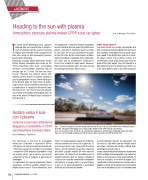
Production manager Dokus Soetemans and his fifteen Belgian colleagues who make up the ‘Punch Powertrain Solar Team’ are budding electronic and mechatronic engineers with an average age of 21 years. For over ten years Leuven University has worked closely with industry partners to offer its masters students a special postgraduate course: Those taking part in the biennial Solar Car Project have to build a single-seater racing car powered entirely by the sun and enter it in contests for the world’s most efficient electric cars. The first aim is to compete successfully in the longest and toughest solar car rally in the world: The World Solar Challenge in Australia (Fig 1).
Andare verso il sole con il plasma
Il plasma a pressione atmosferica alleggerisce l'automobile in CFRP con propulsione a energia solare Inès A. Melamies, Facts4You
Per velocizzare il processo di incollaggio, ottimizzare l’adesione e risparmiare diversi chili di peso, un team di studenti provenienti dal- l’Università Lovanio KU in Belgio ha pretrattato i componenti CFRP della loro automobile racing ad energia solare con il plasma a pressione atmosferica prima di eseguire le operazioni di incollaggio.
Il responsabile del reparto produzione Dokus Soetemans, insieme ai quindici colleghi che in Belgio hanno creato il “Punch Powertrain Solar
The young team – who were entirely responsible for every detail of this one and a half million euro project – had just 15 months to make it a reality. In June 2015 the car was unveiled to the public for the first time, by the end of August all home road tests had been completed and in September the team and its aerodynamic masterpiece Punch One headed off down under. However, before all this could take place, the solar car had to be designed and built from scratch.
EVERY GRAM COUNTS
Less mass means less energy consumption and with a maximum overall weight of 165 kg, Punch One should be 10 kg lighter than its predecessor and a good 25 kg lighter than most of its rivals. Six square meters of the vehicle’s surface are covered with 391 ultra-thin silicon solar cells. Yet despite their light weight, they still amount to a total weight of 8 kg. The heaviest part of the car is the solar battery with a specified maximum
Photo: Punch Powertrain Solar Team
38
compositesolutions n.2/2016
Fig 1 - Powered only by the sun: the energy-efficient Punch One solar car at the World Solar Challenge rally in Australia. The plasma bonding process reduced the weight of the CFRP body by several kilos
Solo con l'energia solare: la Punch One, ad efficienza energetica, al World Solar Challenge rally in Australia.
Il processo di incollaggio al plasma ha ridotto il peso della carrozzeria in CFRP di alcuni chili
Team” ha riunito ingegneri esperti di elettronica e di meccatronica con un’età che si aggira sui 21 anni. Da più di dieci anni l’Università di Lovanio lavora a stretto contatto con partner industriali per offrire ai propri studenti un corso speciale post-laurea. Gli studenti che prendono parte al progetto biennale Solar Car hanno il compito di realizzare una auto da competizione monoposto interamente a energia solare e di partecipare a gare in cui sono protagoniste le automobili elettriche più efficienti del mondo.
Il primo obiettivo consiste nel competere con successo al rally delle auto ad energia solare più lungo e faticoso del mondo: il World Solar Challenge in Australia (fig. 1)
Il team costituito da giovani ingegneri, responsabili di tutti i dettagli di questo progetto, dal costo di un milione e mezzo di euro, aveva tempo soltanto 15 mesi per realizzarlo, e nel mese di giugno 2015 l’automobile è stata presentata per la prima volta al pubblico, entro la fine di agosto erano stati eseguiti tutti i test di collaudo su strada e in settembre sono


