Page 42 - PITTURE E VERNICI EUROPEAN COATINGS Issue 3/May-June 2017
P. 42
LABORATORY
Normalizing with respect to the gravitational constant results in the sedimentation coefficient S [s or Svedberg = 10-13 s], which is frequently used in the technical literature to describe the sedimentation behavior[4]:
By this means, monodisperse samples, that is to say those with uniform particle shape and size, can easily be differentiated from polydisperse samples. The former have only a constant rate of rise for the increase in mass with respect to time, while the latter can exhibit a wider distribution or several defined rates of rise.
EXPERIMENTAL PART
The various calcium carbonate powders (samples 1-3) were investigated. The powders are hydrophobic and are therefore not wetted by water but remain on the surface. Isopropanol was therefore chosen instead as the bulk phase for the sedimentation measurements.
A 1% suspension of each powder sample was prepared in isopropanol. All measurements were carried out with our Force Tensiometer – K100 at room temperature.
Stirring for several minutes with the help of the integral magnetic stirrer ensured a homogeneous initial distribution of the particles.
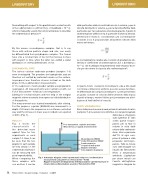
The measurement was started immediately after stirring. For this purpose, a probe (SH0640) was immersed to a depth of 20 mm in the suspension in a software-controlled way and the increase in mass was recorded over a period of 600 s (Fig. 1).
RESULTS
Fig. 2 shows the characteristic of the detected mass against time for two experiments on each sample 1-3. Here, it can be seen that the two graphs for each sample are very similar, i.e. the sedimentation behavior can be measured with good reproducibility. When comparing the three samples with one another, it can be
delle particelle e dalla viscosità del veicolo in volume, ρl per la densità del liquido in volume, ρp per la densità effettiva delle particelle e per l’accelerazione dovuta alla gravità. Il grado di sedimentazione differisce fra le particelle di diversa densità, dimensione e forma e, considerando una concentrazione costante, esso è proporzionale all’aumento rilevato della massa nel tempo:
La normalizzazione relativa alla costante di gravitazione de- termina il coefficiente di sedimentazione S (s o Svedberg = 10-13 s), che è utilizzato frequentemente nelle relazioni tecni- che per descrivere la risposta alla sedimentazione[4].
In questo modo, i campioni monodispersi, vale a dire quelli con forma e dimensioni uniformi, possono essere facilmen- te differenziati dai campioni polidispersi. I primi presentano un grado costante di crescita dell’incremento della massa rispetto al tempo, mentre l’ultimo può presentare una distri- buzione di livelli definiti di crescita.
PARTE SPERIMENTALE
LABORATORIO
Sono state prese in esame le varie polveri di carbonato di calcio (campioni 1-3). Le polveri sono idrofobe, non vengono bagnate dall’acqua e rimangono sulla superficie. E’ stato scelto quindi l’isopro- panolo per la fase in volume in vista delle misure della sedimenta- zione. Una sospensione dell’1% di ogni cam- pione di polvere è stata preparata nell’isopro- panolo. Tutte le misure sono state eseguite con l’ausilio del Tensiometro K100 a temperatura ambiente. L’agitazione per alcuni minuti con l’ausilio dell’agitatore magnetico integrale ha
Force measurement, coupled to tensiometer
Misura di forza, accoppiata ad un tensiometro
Measuring probe SH0640
Sonda di misurazione SH0640
Powder suspension
Sospensione delle polveri
Magnetic stirring bar
Barra magnetica di agitazione
38 Pitture e Vernici - European Coatings - Formulation 3 / 2017
Fig. 1 Schematic diagram of the experimental setup for a sedimentation measurement using the Force Tensiometer – K100
Rappresentazione del diagramma dell’impostazione sperimentale per le misure della sedimentazione usando il Tensiometro K100