Page 72 - PITTURE E VERNICI EUROPEAN COATINGS Issue 3/May-June 2017
P. 72
TECHNICAL NEWS
Alternatives to butyl-based organotin catalysts in two component polyurethane coatings
Alternative ai catalizzatori organostannici a base di butile in rivestimenti poliuretanici bi-componenti
REAXIS/NRC, Hannes Lincke
■ Reaxis is a manufacture company of an extensive range of products that are used in numerous industries including plastics, coatings (paints), elastomers, adhesives, sealants and other industries.
Company offers an alternative to dibutyltin dilaurate catalysts in two component polyurethane coatings: REAXIS® C218.
The use of this product is not
subject to any severe restrictions
and also demonstrates excellent
dry times. Due to increasing
regulations regarding the use of
butyl-based organotin catalysts,
formulators are on the look for
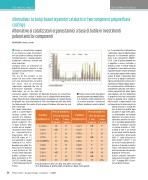
alternative options. Substitutes for dibutyltin dilaurate are of particular interest, since this catalyst is widely used in polyurethane formulations. Image shows the data comparing the physical properties of catalysts based on bismuth, zinc, octyl and methyl tin. The chart shows dry time data while the table presents the results of tests on pencil hardness after one day and after seven days.
■ Reaxis è una società che produce una vasta gamma di prodotti utilizza- ti in numerosi settori industriali, tra cui materie plastiche, rivestimenti (pitture), elastomeri, adesivi, sigillanti
ecc. La società offre un'alternativa ai catalizzatori a base di dibutil stagno dilaurato in rivestimenti poliure- tanici a due componenti: REAXIS® C218. L'uso di questo prodotto non è soggetto a severe restrizioni e dimostra anche eccellenti tempi di asciugatura. A causa della crescente regolamentazione relativa all'utilizzo di catalizzatori organici dello stagno a base di butile, i formulatori sono alla ricerca di opzioni alternative. Sono particolarmente interessanti i sostituti per il dibutil stagno dilaura- to, in quanto questo catalizzatore è ampiamente utilizzato nelle formu- lazioni poliuretaniche. Nella figura sono riportati i dati che confrontano le proprietà fisiche dei catalizzatori basati su bismuto, zinco, stagno di ottile e metile. La figura mostra i dati sul tempo di essiccazione mentre la
tabella presenta i risultati dei test di durezza al graffio dopo un giorno e dopo sette giorni. La formulazione del modello utilizzata è un sistema di rive- stimento a solvente che consi- ste in un poliolo poliammidico idrossile funzionale (fornito in acetato di butile al 70%), acetato di etile e un trimero di isocianato alifatico basato su esametilene diisocianato (HDI). E' stato utilizzato un indicediNCO/OHdi1:1con un carico di catalizzatore di 0,2 di peso in % basato su solidi in resina. I film sono stati svilup- pati ciascuno con uno spessore bagnato di 100 micron. Queste soluzioni innovative sono state presentate all'ECS 2017, il gruppo NRC è il part- ner europeo di Reaxis.
NOTIZIARIO TECNICO
The model formulation used is a solvent-borne coating system that consists of a hydroxyl- functional polyacrylate polyol (supplied 70% in butyl acetate), ethyl acetate and an aliphatic isocyanate trimer based on hexamethylene diisocyanate (HDI). An NCO/OH index of 1:1 was used with a catalyst loading of 0.2 w/w% based on resin solids. The films were each drawn at a wet thickness of 100 microns. These innovative product solutions have been presented at the 2017 ECS, the NRC Group is the European partner of Reaxis.
Pencil hardness after one day and after seven days
Test di durezza al graffio dopo un giorno e dopo sette giorni
Catalyst
Catalizzatore
Pencil hardness
Test di durezza
Catalyst
Catalizzatore
Pencil hardness
Test di durezza
1 day
1 giorno
7 days
7 giorni
1 day
1 giorno
7 days
7 giorni
Control
B
H
C321
HB
F
C125
HB
F
C325
F
F
C214
F
H
C416
F
H
C216
F
H
C423
HB
F
C218 (DBTL)
H
4H+
C616
F
H
C226
H
H
C620
F
F
C228
H
H
C708
F
H
C233
HB
F
C716
HB
H
C314
F
H
C717
HB
H
C320
H
2H
C726
H
4H+
68 Pitture e Vernici - European Coatings - Formulation 3 / 2017