


Page 16 - COMPOSITE SOLUTIONS - Fascicolo 2/2016 - Issue 2/2016
P. 16
w AERONAUTICS
The latest innovations in aircraft passenger experience
The aircraft industry is marked by constant innovation and technological change. It seems like every year new impressive ad- vances are made. In industry news, innovations in the passenger comfort while aboard aircrafts are sometimes overshadowed by other areas such as engineering and technology. Of course, passenger comfort and safety are in many ways the most important aspects of airline industry upgrades today.
In fact, interiors are a $10.5 billion segment of the airline industry.
The composite materials are widely used especially thanks to the saving in weight combined with high fatigue and corrosion resistance. Just think that saving one kilogram of a medium-small aero as the Airbus A320, in a year will save about 300 kg of fuel. With the use of CFRP (carbon fiber polymer resin) you get to a reduction in weight by 20% compared
to aluminum. The composite materials are used in particular for parts of wings and tails, fuselages, antennas, landing gear, floors seats, interior panels etc.
In particular for the production of panels and floors are used in sandwich structures with a core of aluminum honeycomb and carbon fabric or aramid.
These materials reduce the need for overall fatigue and corrosion maintenance tasks while enhancing the jetliner's overall operating efficiency. Guest experience through customized interior designs and increased cabin functionality has increasingly become a focus for airlines as they seek ways to compete. No longer are prices and routes enough. So far 2015 has seen a significant number of announcements around upgrades for comfort ranging from cabin design and re- configuration to in-flight entertainment. Even
Maryruth Belsey Priebe
cultural considerations for different passengers have received attention.
THE IMPORTANCE OF CABIN CONFIGURATION
Cabin configuration can have a significant impact on the experience that each passenger has in flight. Even small changes to the width and construction of seats are noticeable to passengers, especially those flying long distances.
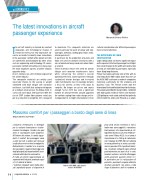
Finnair has taken particular note of this with its new Airbus A350 XWB cabins (more than 53% of the A350 XWB’s airframe is made of composites materials), particularly for the economy and business class. The Finnish airline won the International Yacht and Aviation Award for its design. They emphasized Nordic design motifs, combined with high-quality material choices and dynamic LED lighting to create a look and feel that perfectly reflects both the airline and Finland as a whole.
Massimo comfort per i passeggeri a bordo degli aerei di linea
Maryruth Belsey Priebe
L’industria aereonautica si distingue per la costante innovazione e trasfor- mazione tecnologica. Sembra che ogni anno si susseguano nuovi progressi. All’interno del settore, le novità riguar- danti il comfort dei passeggeri sono a volte lasciate in ombra per dare più risalto alle aree tecniche e tecnologiche. Naturalmente, il comfort e la sicurezza dei passeggeri, rappresentano oggi uno degli gli aspetti più importanti dell’avan- zamento dell’industria aeronautica.
Di fatto, gli interni rappresentano un segmento dell’industria aeronautica pari a 10,5 miliardi di dollari.
I materiali compositi sono molto utiliz- zati soprattutto grazie al risparmio in
peso unito all’alta resistenza a fatica. Inoltre non sono soggetti a corrosione. Basti pensare che risparmiando un chi- logrammo di peso su un aero medio-pic- colo come l’Airbus A320, in un anno si risparmiano circa 300 kg di carburante. Con l’impiego di CFRP (fibre di carbonio in resina polimerica) si arriva a una ridu- zione in peso del 20% rispetto all’allumi- nio. I materiali compositi sono utilizzati particolarmente per parti di ali e code, fusoliere, antenne, carrelli di atterraggio, sedili pavimenti, pannelli interni ecc. In particolare per la realizzazione di pannelli e pavimenti vengono utilizzate strutture sandwich con anima a nido d’ape d’alluminio e pelli in carbonio o
14
compositesolutions n.2/2016
Airbus A350 XWB cabin interior
Interno A350 XWB


